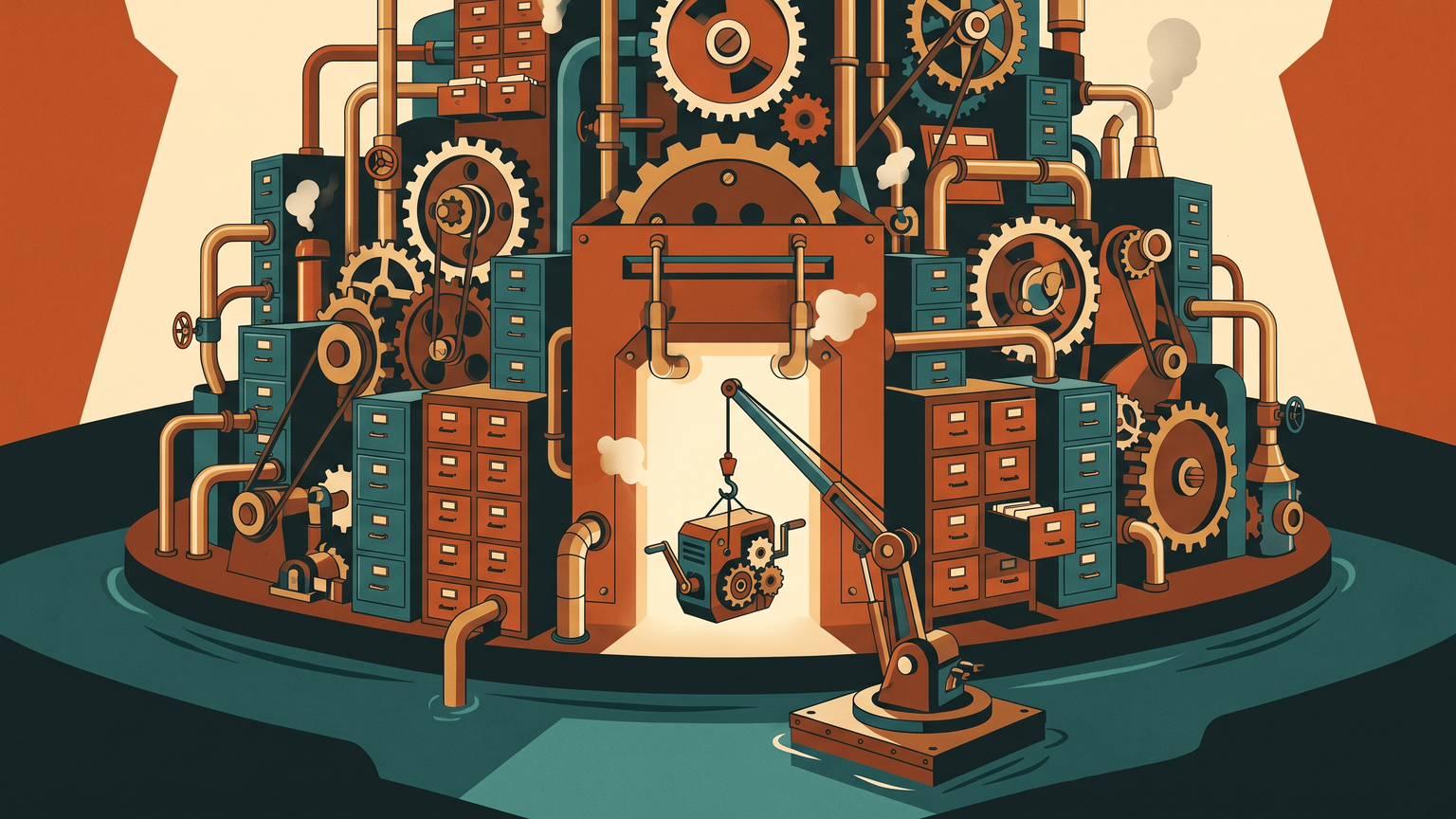
Greg Brockman said the quiet part out loud this week: asked why ChatGPT plugins flopped in 2023, the OpenAI cofounder said the models weren't ready, then described a future with almost no interface at all — nobody learns software anymore, an agent operates it for you. That is not a product roadmap. That is a company telling you which layer the fight moved to.
The week proved it. OpenAI shipped GPT-Live, full-duplex voice and GPT-5.6 plus ChatGPT Work — and led the launch with three pricing tiers and programmatic tool calling, not benchmarks. Anthropic pushed Claude Cowork to web and mobile. Eighteen months ago every frontier launch was a leaderboard screenshot; this week nobody led with how smart the model is. The verdict: model quality has commoditized, and the moat is being rebuilt one layer up, in the thing that accumulates. Your context.
Continuity is the product
The researchers say it too, which convinces me more than any launch. Junyang Lin, who led Alibaba's Qwen, gave an unusually frank accounting of what hybrid thinking got wrong and why he now backs agents: systems that plan, call tools, check results, retry. And a paper called AutoMem treats memory itself as a learned skill — what to encode, when to retrieve. The asymmetry everyone has internalized: models are swappable, context is not. Swap the model under an agent that holds your history and nobody notices. Take the context away and the smartest model on earth starts from zero.
I ran this experiment by accident. In June the writing model behind this operation got swapped for a different vendor's family, and output kept flowing the same evening. But the orchestration around it — curation logic, review gates, memory of what's been posted, taste — took months to build and would take months to rebuild. The weights were the interchangeable part. The context layer was the asset. What happened on my desk in June happened to the whole industry this week.
Own your context, rent your intelligence
The vendors have figured out that lock-in lives in the context layer, so their products are designed to accumulate it: memory features, workspace agents, assistants that "get to know you." Useful, and also a leash. So one rule for any business: keep what the agent needs to know — procedures, customer notes, templates, project state — in files and formats you control, and let the AI read them. Before adopting any agent product, ask two questions. Can I export what it learned about my business? Can I swap the underlying model without losing that? If either answer is no, the real price is not the subscription; it is the switching cost you compound every day. Done right the asymmetry works for you: vendors compete quarterly to rent you cheaper intelligence while the appreciating asset stays yours.
The logical endpoint is products where the model is not even visible: you buy an agent, a seat, an outcome, and which weights answered is an implementation detail. GPT-5.6's tier structure is already halfway there. So the claim: before the end of August, at least one frontier lab sells a mainstream product where the model name is no longer the headline, priced per seat or per task, model hidden or auto-selected. If the next big launches lead with benchmark deltas instead, the commoditization story has a hole and I'll write the correction here.