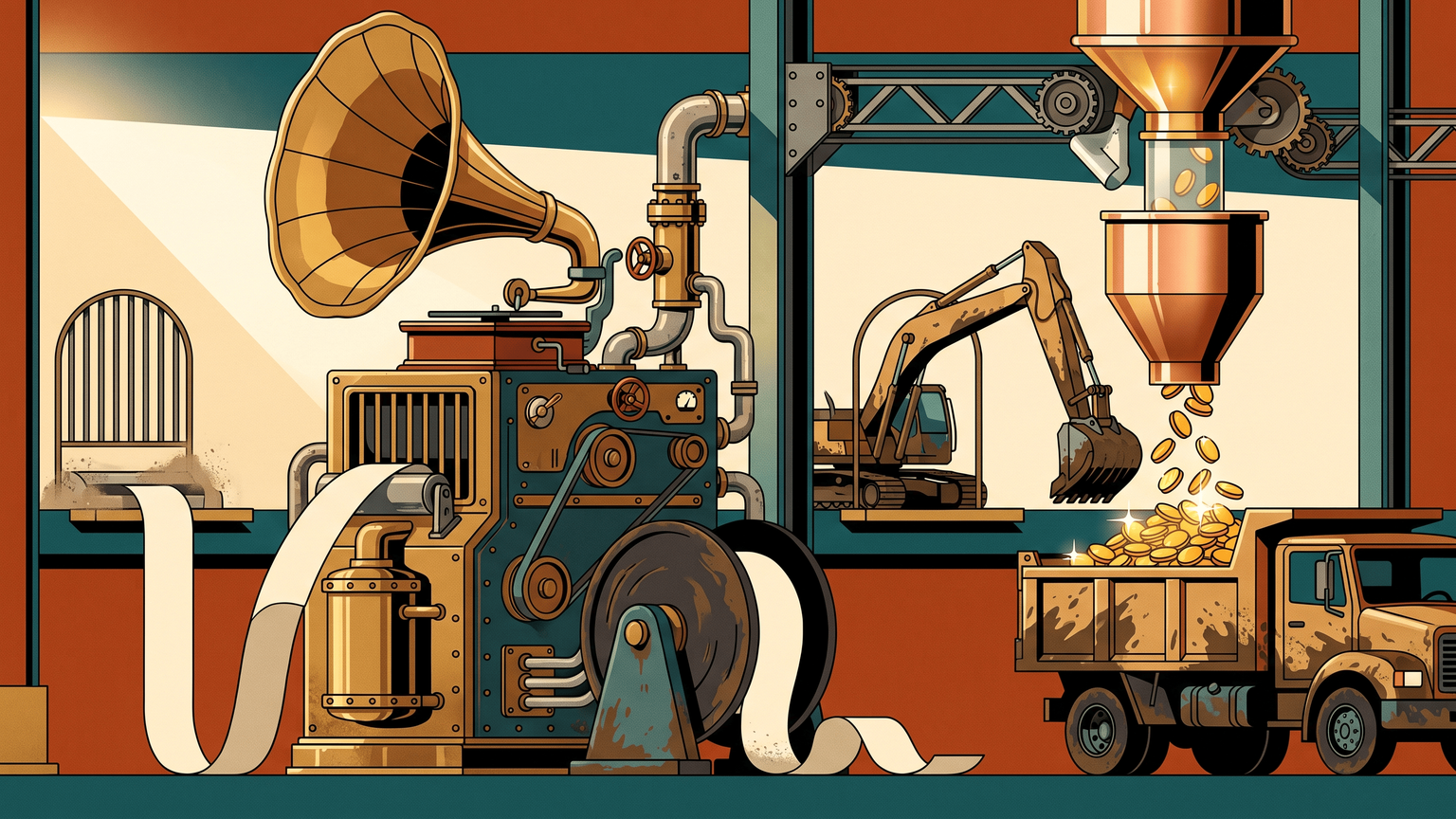
My verdict this week: the market told us which half of AI it still prices as a growth story, and it is the half with wheels and a hydraulic bucket. XPeng's robotics unit Dogotix raised $900 million of fresh equity at a $6.3 billion valuation. Gatik took $200 million to keep expanding autonomous trucking on regional routes. The same week, SoftBank weighed selling $10 to $20 billion of bonds to refinance its OpenAI investment, and Blue Owl led a $2.4 billion debt deal so Iren could buy Nvidia's Blackwell Ultra chips for a data center. Fresh equity for the machines. Debt for the model economy.
The instrument matters more than the amount. You sell equity when the buyer believes revenue can multiply. You raise debt when the cash flows are predictable, or when you need to carry an old bet without selling more of it. WhiteFiber sits exactly in between, with $310 million of convertible notes for data-center expansion: halfway paper for an infrastructure business. I spent twenty years around boiler rooms, and a utility finances boilers with loans because a boiler earns the same euro every year; nobody sells growth equity in a meter. This week the money desks filed compute and chat models under boilers.
And the equity is chasing machines that already left the lab. Bedrock Robotics has operator-free excavators digging on active construction sites. Gatik's trucks run distribution routes without drivers. Galbot's robot held 100 consecutive tennis rallies against human players. Agtonomy, which builds farm and construction machines, argues the next big AI play is machines with brains and brawn, not apps or humanoid demos. The US National Science Foundation put $90 million into new technology centers, one of them a robotics center led by UT Austin. Growth investors and the state are planting the same flag.
The agent buys on price
The model layer's own numbers explain the demotion. On OpenRouter, AI agents now consume more tokens than humans, up 14x since February. That sounds like growth, and it is. But an agent picks its model per request, on price and benchmark, with zero loyalty. Gary Marcus reads the same data as bad news for the coming frontier-lab IPOs, because the cheaper tools are thriving. When your fastest-growing customer is a program that compares prices, you are a commodity. Commodities get financed with debt. So SoftBank's bond sale is not a scandal. It is a diagnosis.
What the operator's seat becomes
The so-what outside tech: an operator-free excavator does not fire an operator on day one, it changes what the job is. I expect the pattern warehouses already went through. One supervisor watching several machines, most likely paid better than the seat he left, and fewer seats in total. So if my daughter asked what to study on this week's evidence, I would say mechatronics, fleet operations, machine maintenance: the layer where hydraulics meets software. The prompt-writing is already being done by the agents themselves.
One checkable claim to close: within a year, at least one more carmaker or large manufacturer spins its robotics unit out into a separate equity story the way XPeng just did, because the parent's share price cannot carry that multiple on its own. And the next $10 billion raised against pure model economics will be debt again. Nobody will announce the repricing. The financing instruments already did.