Function calling
The model answers with a tool call instead of prose — so software can act.
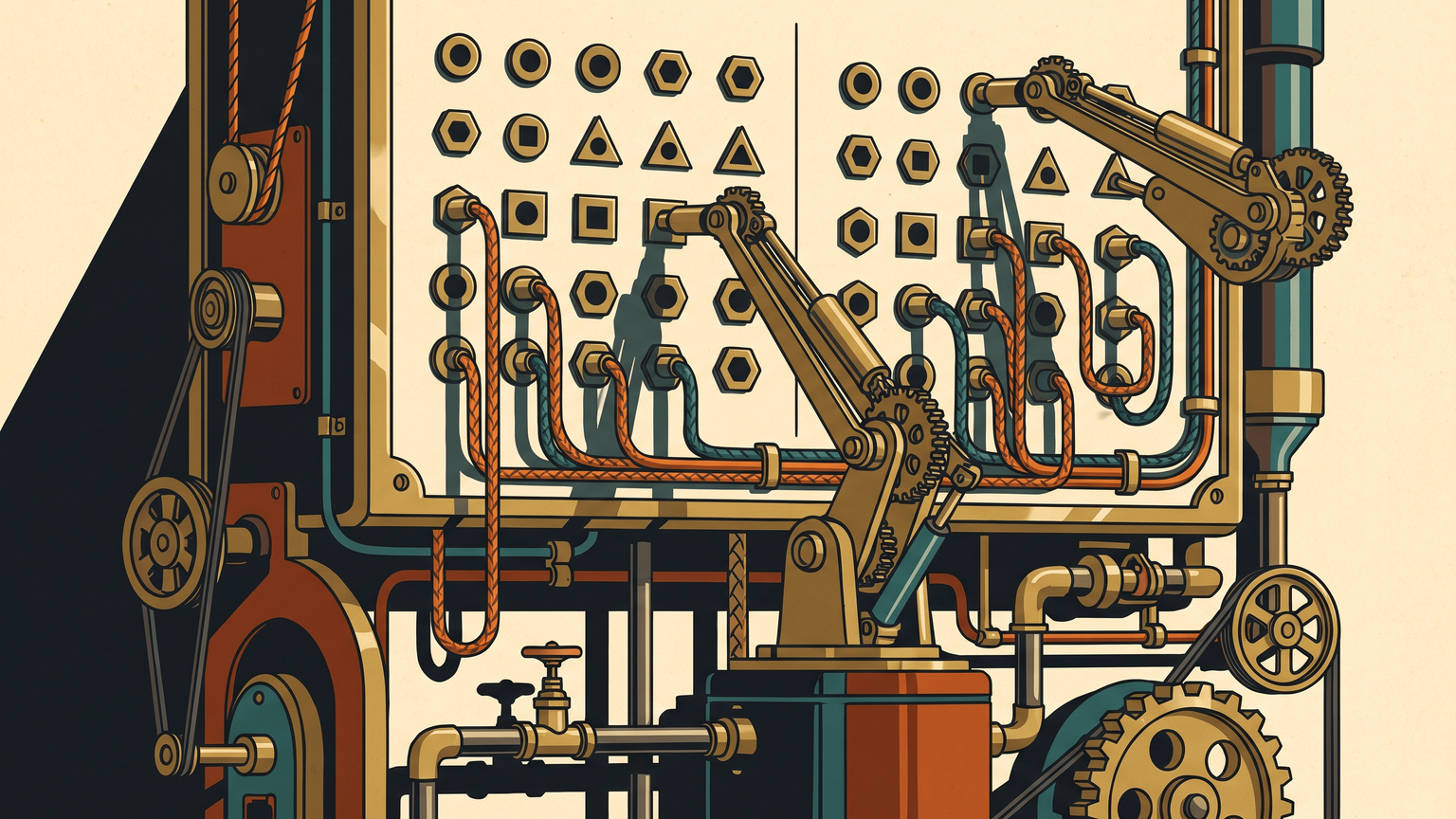
Function calling is the wiring under every AI that books, files, updates or sends anything: you describe the available actions, the model replies with a structured call, your code executes it and reports back. Without it, an AI can only tell your staff what to do next. With it, the same model updates the CRM itself — which also means a wrong call moves real data.
You need this when
- The AI has to touch another system — calendar, CRM, invoicing, stock — not just describe it
- The job is look something up, decide, then act, and today a human copy-pastes between those steps
- You are buying an agent or a workflow tool where 'the AI decides' which branch or app to hit
You can skip it when
- Output is text a human reads and acts on — a plain prompt or a template is enough
- The routing rules are fixed and known — hardcode the branch in Make or n8n; it never guesses wrong
- One irreversible, low-volume action — a button in the software you already own beats a tool schema
The long version — open when you want the depth
What it is — in one coffee-break
Function calling is how a language model stops just talking and starts doing. You describe the actions available — "create_invoice takes a customer and an amount" — and instead of prose, the model answers with a structured request: call create_invoice, customer X, amount Y. Your software executes it and reports back. Every AI agent that books, files, updates or sends anything is built on this loop.
Before function calling existed, developers parsed actions out of free-form model text with pattern matching — brittle and error-prone. Structured tool calls, introduced in 2023 and now supported by every major provider, made "AI that acts" an engineering discipline instead of a party trick.
When you actually need it (and when you don't)
If your AI only produces text for a human to use, you don't need it. You need it the moment the AI should touch another system: check a calendar, update a CRM record, send a reminder. For a small business this usually arrives hidden inside a workflow tool — when Make or n8n lets "the AI decide" which branch to take or which app to update, function calling is doing the work under the hood.
The 2026 landscape splits into two complementary layers. Plain function calling lives inside one application, one provider — simple, fast, fine for a contained product. MCP (Model Context Protocol — covered in the Protocols lesson later in this track) puts the tools on a separate server that ANY AI client can discover and use, with authentication and audit logging built into the protocol. The practical rule from the field: function calling for app-specific logic, MCP for anything you want to reuse across tools — most real systems use both.
How to recognize good vs bad implementations
Function calling (Fc) produces some of the sharpest scores in the audits, because it IS certain products. Zapier scores Fc 9 — its whole 8,000-app catalogue is one giant tool library for agents. ChatGPT and Claude both score 9 with mature, typed tool interfaces; n8n, Make and Windsurf all score 8.5. The failures are equally telling: creative tools with no action surface at all, and platforms that support tools in the demo but fall over on multi-step sequences. The buyer's test: can the AI complete a three-step task — look something up, decide, then act — without a human copy-pasting between steps?
What this costs
Two meters run. Every tool description you offer the model consumes input tokens on every call — with 50+ tools you pay thousands of tokens per request just describing them (one reason MCP's on-demand discovery matters). And every action step is another model call: an agent that takes five steps costs roughly five times a one-shot answer. Budget agents by task, not by message — our pricing table tracks published cost-per-task figures for exactly this reason.
Where to see it scored
Fc with reasons: Zapier (9), ChatGPT (9), n8n (8.5), Make (8.5). And for whether the services your agent must talk to will actually let it in, see our Agent Readiness Index.
Flashcards
Check yourself
1. What does a model return when it makes a function call?
2. Which tools score 9 on Fc in the RXed audits?
3. When should you skip function calling?
4. What is the practical split between function calling and MCP?
5. Why does an agent that takes five steps cost about five times a one-shot answer?
Cheat sheet
- You describe tools; model returns a structured call; your code runs it and reports back
- Buyer's test: three-step task — look up, decide, act — with no human copy-paste
- Fc 9: Zapier, Genspark, Claude, ChatGPT; 8.5: n8n, Make, Windsurf; Cognism 3, Luma AI 2
- Function calling lives inside one app; MCP puts tools on a server any client reuses
- Each tool description costs input tokens on every call — 50+ tools burns thousands
- Budget agents per task, not per message: a five-step run is about five model calls
Who actually does this well
| Best on this element | Score | Why it scored that |
|---|---|---|
| ChatGPT / OpenAI Platform | 9 | The reference implementation of function calling: parallel calls, strict JSON schemas, hosted tools. |
| Claude / Anthropic | 9 | Mature tool use with strict schemas, parallel calls, server tools (web search, code execution), programmatic tool calling and tool search for large tool sets. |
| Composio | 9 | The strongest element and the reason the product exists. Over 1,000 toolkits with typed input and output schemas on a {TOOLKIT}_{ACTION} convention, managed OAuth with automatic to |
| Genspark | 9 | 150+ specialized tools (Python interpreters, database connectors, Crunchbase API, video/image generators) plus terminal, browser and computer access, explicitly designed for tool-c |
| Pipedream | 9 | This is the product and it is the reference implementation. 10,000+ pre-built tools across 3,000+ APIs, managed OAuth so your users connect their own accounts, a Connect proxy for |
| Workato | 9 | A skill is a Workato recipe, which means the tool surface is the connector library itself, and MCP servers add dynamic discovery so a genie picks up new tools at runtime without a |
| Zapier AI (Agents + Copilot) | 9 | 8,000+ maintained app integrations is the deepest tool-calling surface in the business — this is the moat. |
| Cursor | 8.5 | The agent reliably drives terminal, file edits, browser and arbitrary MCP tools; tool use is the product's daily bread and it shows. |
And the other end of the same column:
| Weakest | Score | Why it scored that |
|---|---|---|
| Beautiful.ai | 2.5 | Live data linking pulls external figures into charts and tables, but DesignerBot doesn't autonomously invoke tools or actions; the MCP connector lets other assistants call Beautifu |
| Rilla | 2.5 | The AI reads and scores; it does not act. CRM sync is one-way inbound enrichment via Merge, not model-invoked tool use, and there is no action layer — a gap versus peers in the sam |
| Guild | 2 | Navigator ships automated workflows, for example notifying talent acquisition the moment a learner certifies, but nothing in Guild's public documentation describes model-invoked to |
| Luma AI | 2 | No external tool calling exposed; Luma Agents operate internally within the creative platform and cannot invoke external APIs or actions. |
Scored on 135 of 144 audited tools. Every score links to the full audit and its reasoning.