Context
Everything the model can see on this call, and who decided what goes in.
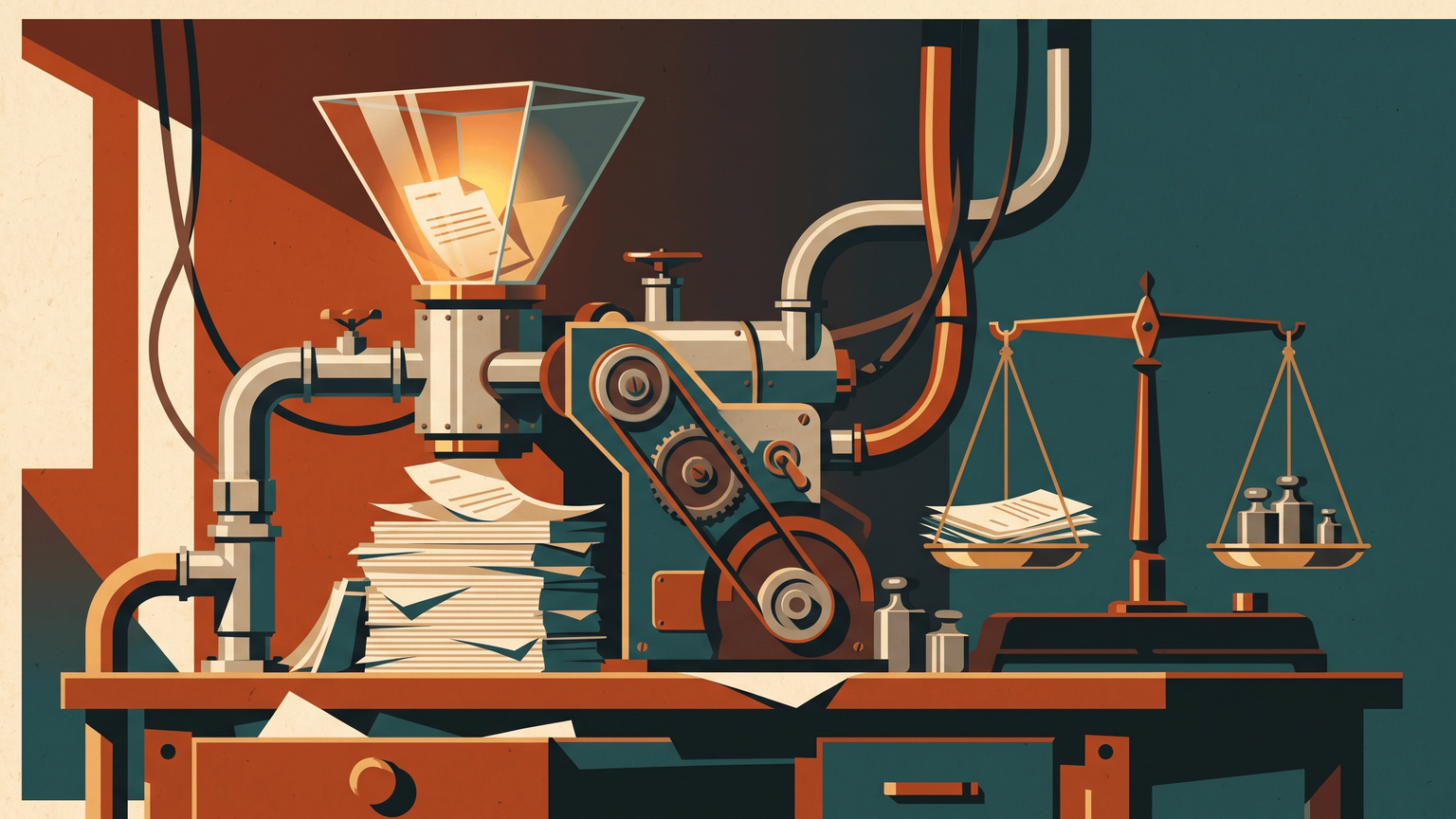
The context window is the model's working memory: your instructions, the conversation so far, the files you attached, the results of tools it just used. Models don't read that window evenly, so facts buried in the middle get missed, irrelevant material distracts, and every extra token costs money and latency. Deciding what enters the window is the rare discipline that cuts your bill and improves answers at the same time.
You need this when
- You are building something that runs repeatedly: a pipeline, a scheduled job, an assistant over your own documents.
- An agent works across many steps and its history keeps growing, so someone has to decide what it keeps and what it summarizes away.
- Output quality has quietly dropped and you are about to blame the model. Check what is going into the window first.
You can skip it when
- One-off chat questions. Skip the engineering, paste the two documents that actually matter and ask.
- Single-purpose creative tools like Udio or Submagic (Cx 5). You cannot steer them with surrounding information anyway, so judge them on output quality instead.
- A small, stable knowledge base of a few dozen pages. Attach it whole rather than building retrieval you will have to maintain.
The long version — open when you want the depth
What it is — in one coffee-break
The context window is the model's working memory: everything it can "see" while answering — your instructions, the conversation so far, the documents you attached, the results of tools it just used. Context engineering is deciding what goes into that window, in what order, on every single call. If prompt engineering is how you phrase the instruction, context engineering is designing the whole system that feeds the model the right information at the right time.
It became the defining discipline of applied AI because of a stubborn truth: models don't use their windows evenly. Facts buried in the middle of a long context get missed ("lost in the middle"), irrelevant material actively distracts, and every extra token costs money and latency. A million-token window doesn't repeal any of that — it just gives you more rope.
When you actually need it (and when you don't)
For a chat session, you don't — paste what matters, ask your question. You need context engineering when you build anything that runs repeatedly or acts over multiple steps: an assistant over your knowledge base (what gets retrieved and included?), an agent doing a task (what history does it keep, what does it summarize away?), a pipeline like the one that publishes this site (which stories, in which order, with which instructions?). In each case someone has to decide what enters the window — and if nobody decides, the window fills with noise and quality quietly degrades.
The working rules from practice: put stable content first and variable content last (that's also what makes provider-side caching work); include only what the current step needs; summarize old turns instead of carrying them verbatim; and measure — when output quality drops, the context is the first suspect, not the model.
How to recognize good vs bad implementations
Context (Cx) is where the agent-era leaders separate from the pack in our audits. Claude scores 9.5 — context management is arguably Anthropic's core product idea, from prompt caching to context editing for agents. NotebookLM scores 9 by doing one thing perfectly: keeping the model grounded in exactly the sources you gave it, nothing else. Gemini scores 9 with the largest practical windows. Compare that with single-purpose creative tools (Udio: Cx 5) where you can barely steer the model with any surrounding information at all. The question to ask any vendor: what does your tool put into the model's window, and can I see it? Tools that can't answer are guessing on your behalf.
What this costs
Context is the meter that runs. Input tokens are the biggest line on most AI bills — a bloated 50,000-token context on every call costs 25× a disciplined 2,000-token one, for often worse answers. Good context engineering is the rare practice that cuts cost and improves quality at the same time. Check our Model Pricing calculator with your own daily token volumes to see the difference discipline makes.
Where to see it scored
Cx scores with reasons: Claude (9.5), NotebookLM (9), Gemini (9), Windsurf (8.5). Related lessons: Prompts (the instruction layer) and RAG (the retrieval layer that fills the window).
Flashcards
Check yourself
1. In the RXed audit of 62 tools, which scores highest on Context (Cx)?
2. What does a one-million-token window actually solve?
3. Where should stable, unchanging content sit in your context?
4. Roughly how much more does a 50,000-token context cost than a 2,000-token one?
5. Which of these genuinely needs context engineering?
Cheat sheet
- Stable content first, variable content last. That is also what makes caching hit.
- Include only what this step needs. Just-in-case context gets paid for on every call.
- Summarize old turns instead of carrying them verbatim; agents drown in their own history.
- 50,000 tokens a call costs 25x a disciplined 2,000, often for a worse answer.
- A big window is more rope, not a fix: facts buried mid-context still get missed.
- Ask the vendor: what goes into the model's window, and can I see it?
Who actually does this well
| Best on this element | Score | Why it scored that |
|---|---|---|
| Claude / Anthropic | 9.5 | 200K default up to 1M context, Files API, prompt caching, context editing, compaction, memory tool and Projects — context engineering is arguably the deepest in the industry. |
| Writer | 9.5 | Palmyra X5 ships a 1M-token context window and Writer now sets 1M tokens as its minimum for all future model releases — an industry-first commitment, paired with Knowledge Graph fo |
| Abridge | 9 | The Contextual Reasoning Engine pulls prior encounters, ED documentation, nursing assessments, labs, imaging and health-system guidelines into every note. Best-in-class context ass |
| ChatGPT / OpenAI Platform | 9 | Long context windows, hosted file search, context caching and project-level knowledge — best-in-class context management. |
| Gemini / Google | 9 | Million-token context windows across the Gemini line, context caching, file handling and NotebookLM as a consumer-grade context surface. |
| Glean | 9 | Enterprise Context is a named platform pillar: Personal Graph, Enterprise Graph, an 'Enterprise Memory' of playbooks, plus meeting transcripts as first-class searchable context. |
| NotebookLM | 9 | Full 1M-token Gemini context in chat on all plans (since 01/2026), up to 600 sources × 500k words each, saved conversation history and Drive integration — best-in-class context man |
| Ambience Healthcare | 8.5 | Chart awareness is the product's spine: the AI reads prior notes, diagnoses, labs, imaging, medications, pathology and problem lists rather than one encounter's transcript. Chorus |
And the other end of the same column:
| Weakest | Score | Why it scored that |
|---|---|---|
| Freed | 4.5 | Visit prep and pull-forward patient context exist but only on the $119 Premier tier, and context comes from Freed's own prior notes rather than the chart. No file upload, no docume |
| Webflow | 4.5 | Generation is scoped to a per-session prompt plus the workspace's own CMS content; there's no persistent file/knowledge attachment surface or context-window management for customer |
| Beautiful.ai | 4 | Users can hand the generator source files and links as extra context per deck, but there's no persistent knowledge base and no documented handling of long or multi-document inputs. |
| Guild | 4 | The AI works from learner records, the curated catalogue of 2,000+ programs and employer-configured eligibility, and Navigator adds cohort, milestone and compliance state as contex |
Scored on 144 of 144 audited tools. Every score links to the full audit and its reasoning.