Multi-agent
Several agents on one job — rarely worth the 15x token bill.
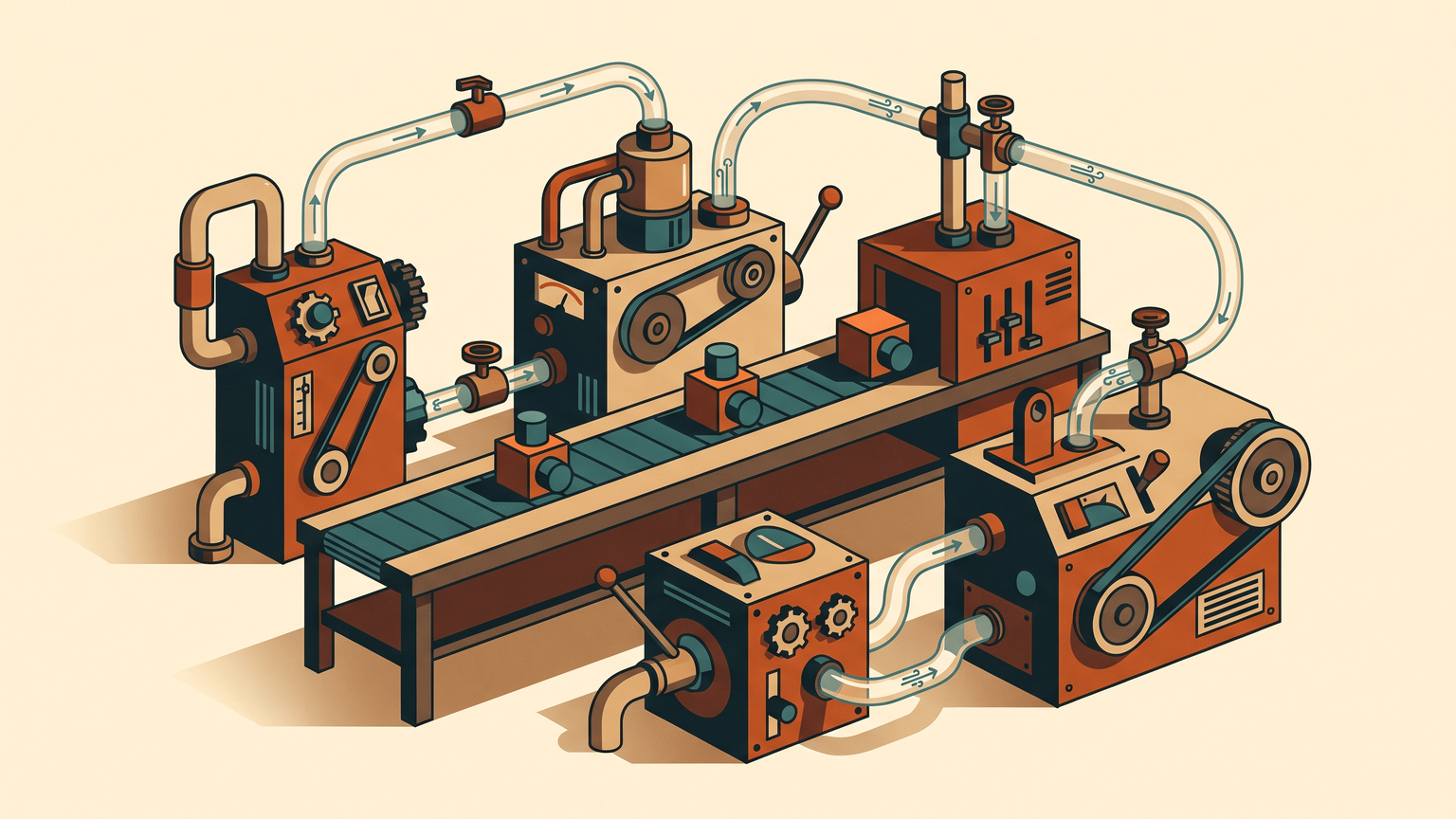
Multi-agent is the difference between one AI doing your job and a lead agent farming pieces out to specialists. It genuinely wins on read-heavy parallel work — 40 supplier pages, 300 CVs — where subtasks are independent and read-only. Everywhere else it multiplies token cost and failure surface, and one well-instrumented agent beats the swarm.
You need this when
- You run read-heavy parallel research: dozens of sites, CVs or suppliers checked at the same time, independently.
- Your roles need different tools or permissions — e.g. a voice agent that hands off to the only agent allowed to write to the calendar.
- One job's context genuinely exceeds a single window, and the pieces can be summarised back without losing decisions.
You can skip it when
- Your workflow is sequential and each step depends on the last — use one agent with good tools and a checklist prompt instead.
- The task is writing or coding, where subagents make invisible conflicting decisions — use one agent plus a human review gate instead.
- You just want it to look sophisticated in a demo — spend the money on logging, evals and a retry policy for your single agent instead.
The long version — open when you want the depth
What it is — in one coffee-break
Multi-agent means more than one AI agent on the same job: a lead agent splits the task, hands pieces to specialists, and stitches the results back. Three shapes turn up: handoff (support agent passes the ticket to billing), delegation (an orchestrator spawns four researchers, merges findings), debate (two argue, a third judges). The test is blunt: does the product genuinely support agents working together, or does it call one model repeatedly and print the steps with job titles on?
This sits in the Emerging row, and Emerging means unsettled. Anthropic found a lead-plus-subagents setup beat a single agent by 90.2% on their internal research eval — while burning roughly 15x the tokens of a chat, with token usage alone explaining 80% of the performance variance. Much of the "multi-agent is smarter" effect is simply "we spent 15x more".
When you actually need it (and when you don't)
Handoffs genuinely help in two places. First, read-heavy parallel work: 40 supplier price pages, 300 CVs, a dozen competitor sites. The subtasks are independent, read-only, and each fits its own context window, so nothing collides. Second, role separation where roles carry different tools and permissions — a voice agent that answers, then hands the caller to the one agent allowed to write to your calendar. That buys a permission boundary, not brains.
Theatre: anything sequential, anything with shared evolving state, and most writing and coding work. Cognition put it bluntly in Don't Build Multi-Agents: parallel subagents make implicit decisions the others cannot see, so one built a Super Mario background for the Flappy Bird clone another was drawing. The MAST taxonomy points the same way: 14 distinct failure modes across seven popular frameworks, mostly coordination failures rather than model failures.
Default for a small business: one well-instrumented agent with good tools and full logs. Add a second only when you can name the subtask, prove it is read-only, and show it runs alongside its siblings, not after.
How to recognize good vs bad implementations
Good implementations expose the seams: you see which agent ran, what it was told, what it returned, and what the orchestrator did with it. Bad ones show an animated list of role names — Researcher, Analyst, Writer — over one prompt chain in costume.
Three questions that end a sales demo quickly. Show me the trace: which agent produced this sentence, and what did it cost in tokens? No per-agent trace and no per-agent token count means you can neither debug nor budget it. What happens when subagent three returns garbage — retry, drop, or pass through? That should be a named policy, not a shrug. Can two agents run at once, or is this a queue? A queue means you pay multi-agent prices for sequential work.
One more tell: good products cap subagent count and token budget per run, and treat human escalation as a first-class handoff.
What this costs
At July 2026 rates — Claude Sonnet 5 at $2 per million input tokens and $10 output, Opus 5 at $5 and $25 — a single-agent research brief using 80k input and 10k output costs about $0.26 (EUR 0.24). The same brief as an Opus orchestrator with four Sonnet subagents, at the measured 15x multiplier, lands near $4 to $6 (EUR 3.70 to EUR 5.50). Two hundred briefs a month: EUR 48 against EUR 800 to EUR 1,100. That gap must buy something you can name.
Hosted orchestration adds a layer. CrewAI's cloud free tier allows 50 executions a month; Professional is $25 a month for 100 executions and two users, and you still bring your own LLM keys. Published per-run figures for a three-agent crew: $0.06 to $0.12 on GPT-4o-mini, $0.10 to $0.20 on GPT-4o, and $1.50 to $12 per hour in sustained production.
The self-hosted path is cheap on licence: CrewAI, LangGraph and the OpenAI Agents SDK are open source, and a VPS runs EUR 5 to EUR 20 a month. You do not escape tokens — over 90% of the bill, and self-hosting does not shrink them. Open-weight models on a EUR 1,500 to EUR 2,500 workstation delete the token line, but small models coordinate badly — the exact thing you were buying.
Where to see it scored
We audited 62 tools; 37 carry a score here. Top: Genspark (9) and Gemini / Google (9), both running genuine parallel subagents with visible per-agent output. Vapi (8) scores on voice handoffs between agents holding different tools; Claude / Anthropic (8) on subagent delegation with per-agent context isolation. The bottom is where the marketing lives: Cognism (2.5) and Base44 (2) use agent language for one model on a chain. Read Anthropic's numbers against Cognition's counter-argument: they disagree, and both are right about different tasks.
Flashcards
Check yourself
1. Anthropic's multi-agent research system used roughly how many times the tokens of a chat?
2. Which task is the best genuine fit for multi-agent?
3. What did the MAST taxonomy find most multi-agent failures were?
4. Which question best exposes fake multi-agent in a demo?
5. At July 2026 Claude rates, what does a 200-brief month cost multi-agent vs single-agent?
Cheat sheet
- Handoff, delegation, debate — three shapes; only handoff is usually worth it.
- Anthropic: 15x tokens vs chat; token spend alone explains 80% of the gain.
- MAST: 14 failure modes across 7 frameworks — coordination, not the model.
- Parallel + read-only + independent = good. Sequential + shared state = theatre.
- Demand per-agent traces and per-agent token counts, or you cannot budget it.
- EUR 0.24 per brief single-agent vs EUR 3.70-5.50 multi-agent. Name the payoff.
Who actually does this well
| Best on this element | Score | Why it scored that |
|---|---|---|
| Gemini / Google | 9 | Google authored the A2A protocol (50+ partners), Agent Engine runs A2A agents in production, and ADK/Antigravity ship multi-agent orchestration with subagents. |
| Genspark | 9 | A dedicated Multi-Agent Platform: a lead agent coordinates multiple specialized sub-agents in parallel with shared context, and can spin up new ephemeral agents defined by their ow |
| Workato | 9 | Two coordination paths, both documented. Internally, a genie delegates with Assign task to genie and gets a structured response back, with a conversation ID for chained calls and d |
| Amazon Bedrock AgentCore | 8.5 | A2A shipped on Runtime at GA and AWS has demonstrated a Google ADK orchestrator coordinating Strands and OpenAI SDK agents on one platform. AWS Agent Registry went GA in August 202 |
| Corti | 8.5 | Hierarchical orchestrator-and-Experts design with parallel fan-out, deterministic workflows and state-graph routing. Multi-agent is the default shape here, not an add-on pattern. |
| Gemini Enterprise Agent Platform | 8.5 | Google wrote A2A and reports v1.0 in production at 150 organisations; ADK does multi-agent orchestration natively, Agent-to-Agent Orchestration is a platform service, and Agent Gat |
| Hippocratic AI | 8.5 | The strongest multi-agent surface audited so far. Agentic Orchestrators, launched 13/08/2026, coordinate teams of specialist agents under a supervising orchestration brain that dec |
| LangGraph | 8.5 | Supervisor, swarm, hierarchical and free-form network patterns are all documented, with langgraph-supervisor and langgraph-swarm as prebuilt packages and handoffs persisted through |
And the other end of the same column:
| Weakest | Score | Why it scored that |
|---|---|---|
| Orum | 2 | Orum now markets AI Roleplay Agents and Scout data agents in the plural, so an agent surface exists, but nothing coordinates, delegates or hands off between them — one dialer, one |
| Suki AI | 2 | The platform is modular, not multi-agent. No documented delegation, handoff or agent-to-agent coordination surface. |
| tl;dv | 2 | Nothing coordinates multiple agents. Fair for a notetaker, but a vendor selling 'AI Agents' as a headline feature invites the comparison. |
| Avoma | 1.5 | No multi-agent orchestration, delegation or handoff anywhere in the product. Whatever coordination happens is inside your own Claude or ChatGPT workspace, not inside Avoma. |
Scored on 128 of 163 audited tools. Every score links to the full audit and its reasoning.