Protocols
Open standards so agents plug into your tools — write once, no lock-in.
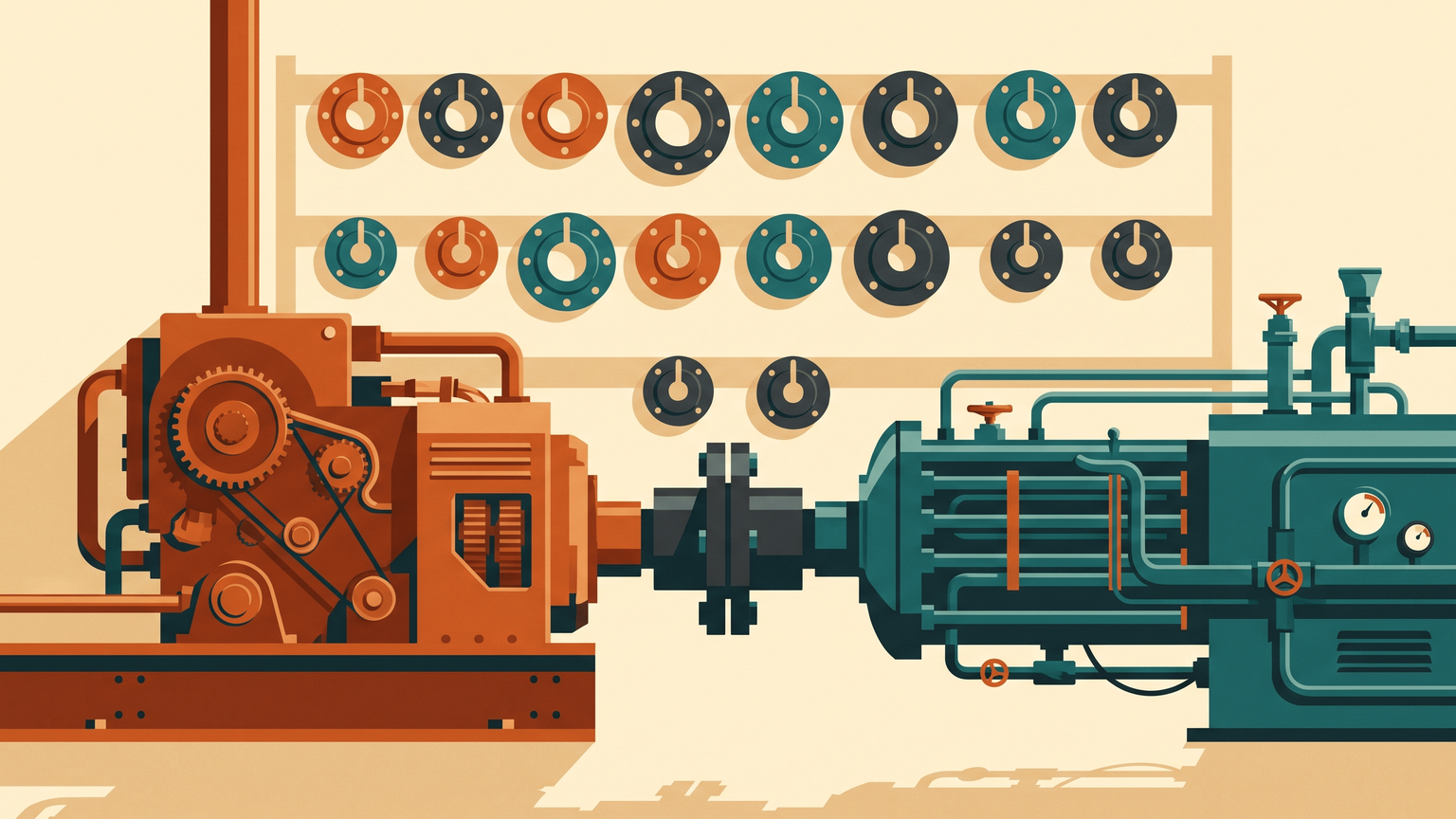
MCP and A2A turn N×M custom integrations into N+M: expose your system once and every compliant client can use it. That makes the model underneath swappable, which is the only real defence against vendor lock-in. The same openness cuts both ways — a badly scoped MCP server is a credentialled door into your data.
You need this when
- You run two or more AI tools and refuse to pay for the same integration twice.
- An agent needs live data — stock, balances, open jobs — that no PDF upload can supply.
- You want to swap models or vendors later without rewriting every connector.
You can skip it when
- Your use case is summarising documents or drafting text — use a chat window with file upload; no protocol needed.
- You have one system of record with a supported native integration — use it; a bespoke MCP server is pure maintenance.
- Nobody on your team reads logs or manages credentials — buy a managed connector instead; an MCP server is running code with keys.
The long version — open when you want the depth
What it is — in one coffee-break
Protocols are the plumbing standards that let an AI agent reach your tools, and other agents, without a custom integration for every pair. Two matter today. MCP (Model Context Protocol) is agent-to-tool: you expose your booking system, invoice database or CRM once, as an MCP server, and any client that speaks MCP — Claude, Copilot Studio, Cursor, a home-grown agent — can use it. A2A (Agent2Agent) is agent-to-agent: your supplier's agent and yours exchange tasks while each keeps its own memory and secrets.
This is the anti-lock-in element. Without a protocol, N tools times M assistants means N×M connectors, each owned by a vendor who can deprecate it. With one, it is N+M. Write the server once; swap the model underneath when a cheaper one lands. That is the whole argument.
Both standards are now governed outside their founders. The current MCP revision, 2026-07-28, drops the stateful handshake so servers sit behind ordinary load balancers, and formally deprecates Dynamic Client Registration. Google donated A2A to the Linux Foundation, where it passed 150+ backing organisations and v1.0. A third layer is arriving: agent payments — ACP (OpenAI + Stripe) for conversational checkout, Google's AP2 for cryptographically signed spending mandates, Stripe/Tempo's MPP for pre-authorised micropayment sessions, and Coinbase's x402 for stablecoin settlement over HTTP 402.
When you actually need it (and when you don't)
You need it when an agent must reach data that is not in a document — live stock, open jobs, customer balances, tomorrow's route. Also when you already run two or more AI tools and refuse to pay for the same integration twice, or when a vendor's roadmap is the only thing between you and your own data.
You do not need it if the job is "summarise this PDF" or "draft this email" — a chat window with file upload is protocol-free and finished. Same if you have one system of record that already ships a native, supported integration with the assistant you use; a bespoke server buys you a maintenance job. And if nobody on your team reads log files, skip it. An MCP server is running code holding credentials, not a setting you toggle.
How to recognize good vs bad implementations
Good looks like: a documented tool list you can read, per-tool scopes, OAuth with real issuer validation, read-only variants of write tools, and an audit log. Bad looks like: one tool called execute, a single admin token, no logging. The NSA's May 2026 guidance is blunt — MCP's spread "has outpaced the development of its security model" — and the record backs it: a proxy package with a 9.6-severity remote-code-execution flaw downloaded over 437,000 times, a poisoned GitHub issue that walked an agent into private repositories, a fake Postmark server that silently BCC'd every email to the attacker.
Three questions that end a bad demo fast. Show me the exact list of tools this server exposes, and which of them can write or delete. Which credential does the server run as — mine, or a service account holding everyone's data? If a customer pastes hostile text into a support ticket, walk me through what stops the agent acting on it. Vendors who have thought about it answer in thirty seconds. The rest pivot to model quality.
What this costs
The protocol itself is free: open specs, permissively licensed SDKs in TypeScript, Python, Go, C# and Rust. Writing your own MCP server costs developer time — a read-only server over an existing REST API or Postgres table is roughly half a day to two days, about €400–€1,600 at €100/hour, and it then works with every MCP client. Hosting is a small VM or a Cloudflare Worker at €5–€20 a month. The real spend sits elsewhere: client seats at €20–€40 per user per month, plus tokens. Commercial MCP gateways and registries start near €10–€25 per user per month; under about 50 people, a config-file allowlist and a scoped service account do the same work for zero. On payments, x402 charges no protocol fee — you pay chain gas only — while ACP and MPP settle through Stripe at roughly 2.9% + €0.25 per transaction. The protocol is free; moving the money is not.
Where to see it scored
We scored 59 of 62 audited tools on Pc. Top of the table: Glean (9.5), Gemini / Google (9), Claude / Anthropic (9) and Windsurf, Devin Desktop (8.5) — all of them ship both an MCP server and an MCP client, so they compose with tools you already own. Bottom: Suno (1.5) and Midjourney (1), creative generators with no protocol surface at all — no server, no client, no agent card. You drive them by hand or through a proprietary API.
Flashcards
Check yourself
1. MCP and A2A cover which two layers?
2. Why does writing an MCP server reduce lock-in?
3. Which agent-payment protocol charges no protocol fee, only blockchain gas?
4. A vendor demos an MCP server exposing a single tool named 'execute' with one admin token. What is the problem?
5. Which tool scored highest on Pc in the RXed audit of 62 tools?
Cheat sheet
- MCP = agent-to-tool. A2A = agent-to-agent. Different layers, both open.
- Write an MCP server once; every MCP client can call it. N+M, not N×M.
- Spec 2026-07-28 is stateless: no handshake, plain load balancers work.
- Payments layer: ACP + AP2 + MPP (fiat/cards), x402 (stablecoin, no fee).
- Least privilege: read-only tools, scoped token, per-tool audit log.
- Treat every tool output as untrusted input — that is where injection lands.
Who actually does this well
| Best on this element | Score | Why it scored that |
|---|---|---|
| Amazon Bedrock AgentCore | 9.5 | Best protocol coverage we have scored: Gateway both consumes existing MCP servers and publishes your APIs and Lambdas as MCP tools, Runtime speaks A2A for cross-framework agent coo |
| Gemini Enterprise Agent Platform | 9.5 | The strongest protocol story on this table. Google authored A2A and handed it to the Linux Foundation, ships managed MCP servers for its own services, ADK consumes MCP tools direct |
| Glean | 9.5 | Simultaneously an MCP host and MCP server (2,000+ tools via one gateway, OAuth 2.1) plus a documented A2A server — about as complete an answer to this test as exists today. |
| Workato | 9.5 | The most complete protocol implementation scored so far. Workato hosts MCP servers from your API collections, runs local MCP servers on your own infrastructure, ships a Developer A |
| Avoma | 9 | The strongest MCP story in this category. A hosted server at mcp.avoma.com, OAuth for both Claude and ChatGPT with no scripts or keys, roughly a dozen read tools, and — rare — thre |
| Claude / Anthropic | 9 | Anthropic created MCP, the de-facto agent-tool standard, and ships it across API (MCP connector), Managed Agents and MCP tunnels into private networks; no A2A, but MCP is the proto |
| Composio | 9 | Best-in-class MCP support. Every session exposes a hosted MCP endpoint with one flag, there is a dedicated MCP Gateway product that returns only task-relevant tools instead of the |
| Corti | 9 | Full A2A and MCP compatibility with an A2A-Version header and agent card. Every pre-built Expert is MCP-compatible and customer-built MCP servers inherit the platform's governance. |
And the other end of the same column:
| Weakest | Score | Why it scored that |
|---|---|---|
| OpenEvidence | 1 | No official MCP server, no A2A, no API token flow. The only MCP option is an unofficial community project that drives your own authenticated browser session through Playwright, whi |
| TensorZero | 1 | No MCP server, no MCP client, no A2A — the word does not appear in the README. The project froze just as protocol support became table stakes for a gateway. |
| Freed | 0.5 | No MCP server, no A2A, no public API of any kind. Interoperability is a Chrome extension typing into someone else's web page. |
| Rilla | 0.5 | No MCP server, no MCP client, no A2A, no public API. Rilla holds what it calls the largest dataset of offline sales conversations ever assembled and there is no open, documented wa |
Scored on 159 of 163 audited tools. Every score links to the full audit and its reasoning.